

How the Iran Conflict Is Reshaping Aviation: Airspace Closures, Rerouted Flights
On 28 February 2026, coordinated strikes on Iran triggered the biggest aviation crisis since the Russia-Ukraine war and Covid closing airspace across eight countries, grounding 40,000+ flights, and sending private charter demand to record highs.
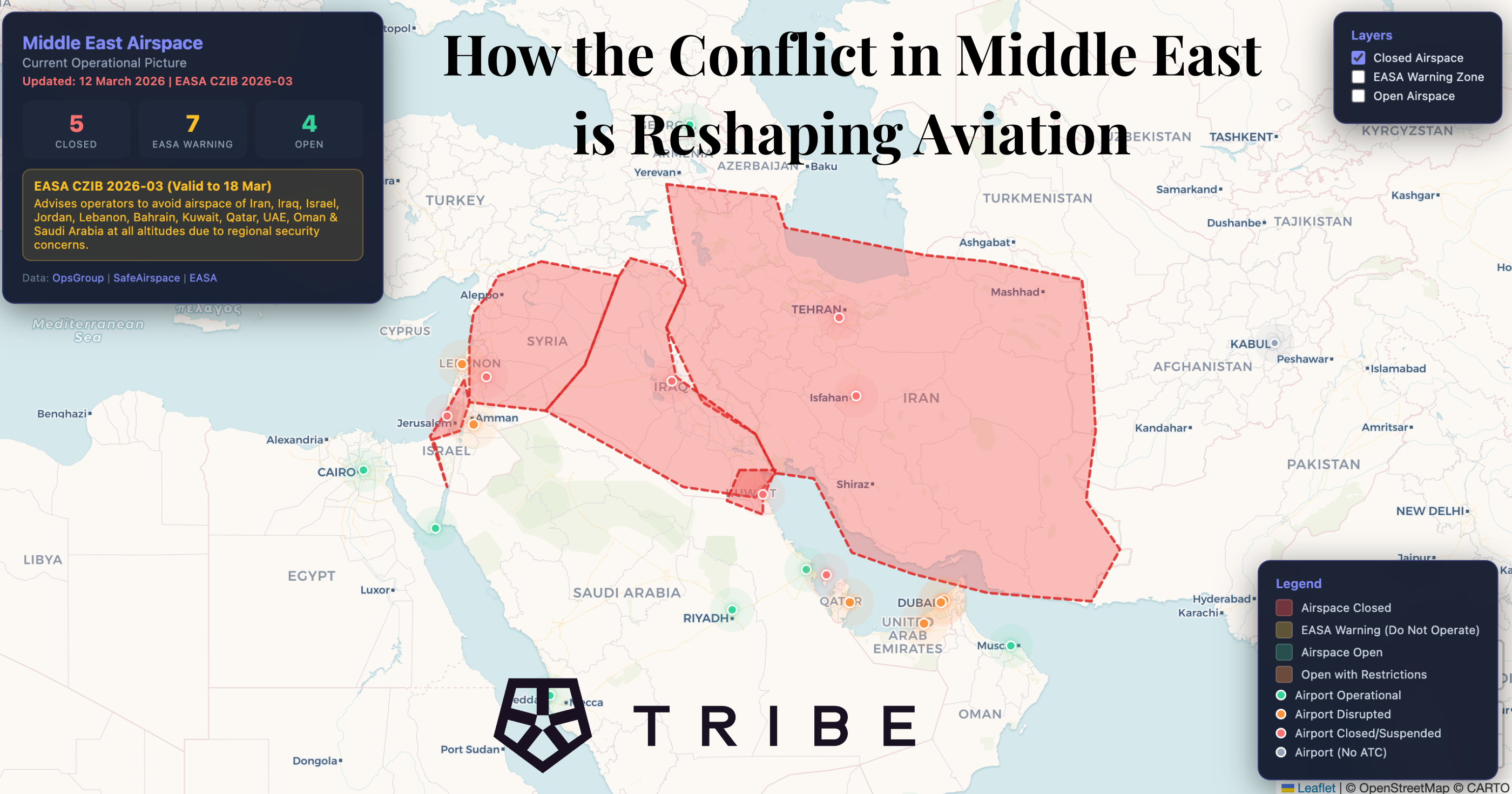
Table of content
On 28 February 2026, the United States and Israel launched coordinated military strikes on Iranian military targets. Iran's retaliatory missile and drone launches across the region triggered an immediate and far-reaching aviation crisis, one that has disrupted tens of thousands of flights, shut down the world's busiest international airport, and sent shock waves through commercial and private aviation worldwide.
Two weeks on, the crisis shows no sign of abating. The European Union Aviation Safety Agency (EASA) has extended its Conflict Zone Information Bulletin (CZIB 2026-03) through to 18 March, warning operators to avoid airspace across eleven Middle Eastern states at all altitudes. For the global aviation industry, the consequences have been swift, severe, and deeply interconnected.
Eight Countries, One Massive No-Fly Zone
Within hours of the initial strikes, at least eight countries declared their airspace closed or severely restricted: Iran, Iraq, Israel, Jordan, Kuwait, Bahrain, Qatar, and the United Arab Emirates. Lebanon and parts of Saudi Arabian and Omani airspace followed with heavy restrictions shortly after.
The closed zone sits at the geographic centre of modern long-haul travel. Roughly 30 per cent of all international air traffic passes through or over this corridor on any given day. When it shut down, the ripple effects were felt from Sydney to London, from Mumbai to New York.
Partial Closure of Dubai International (OMDB) and Al Maktoum (OMDW)
Perhaps the most alarming development for the aviation industry was the closure of Dubai International Airport (OMDB) — the world's busiest airport for international passengers, which handled a record 95.2 million passengers in 2025.
Partial operations resumed on 7 March, with both DXB and DWC operating a limited flight schedule under strict conditions. As of 12 March, Dubai Airports has instructed travellers not to proceed to either airport unless their airline has directly confirmed that their specific flight is operating. Emirates and flydubai have resumed limited schedules, but capacity remains a fraction of normal.
Abu Dhabi International Airport (AUH) was similarly affected. Baghdad, Tehran, and multiple airports across the Gulf suspended operations entirely during the initial wave.
40,000+ Flights Disrupted
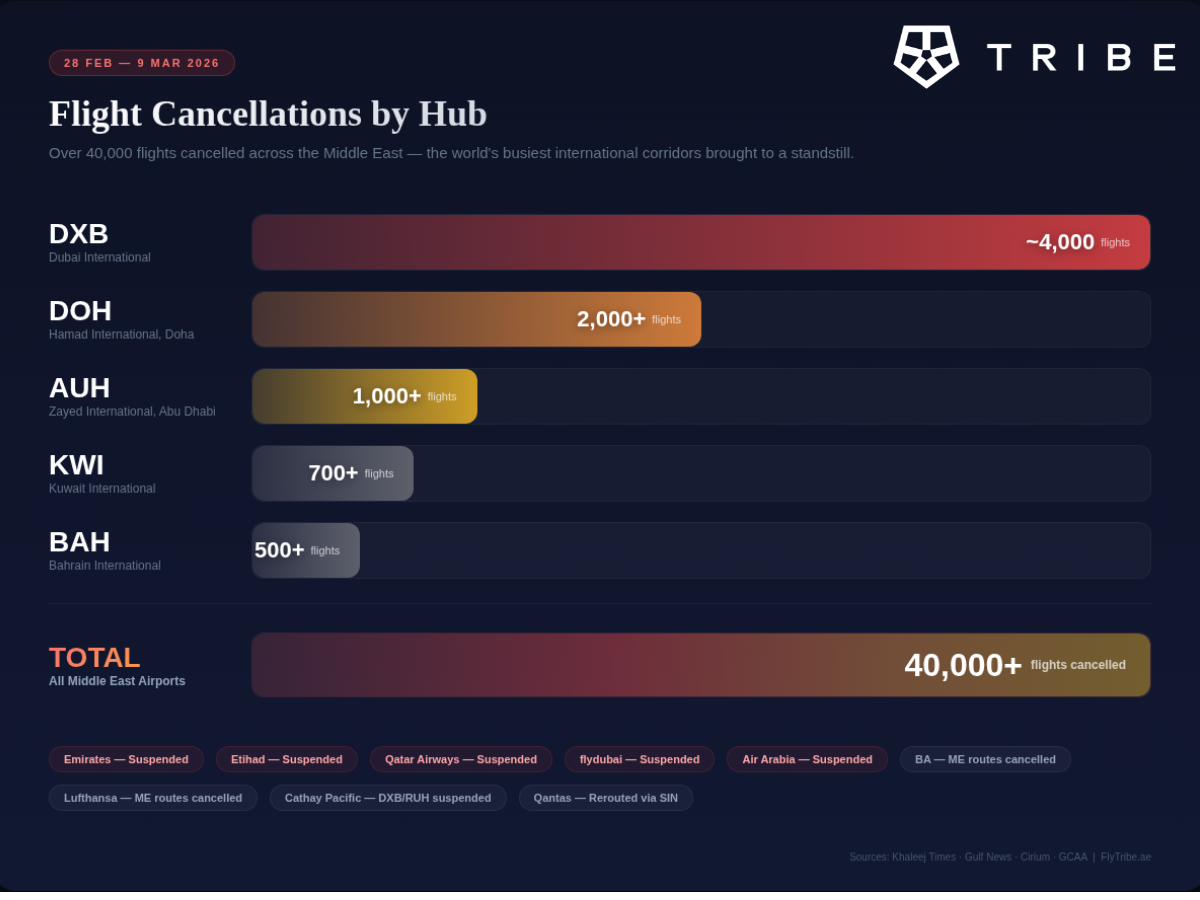
The scale of cancellations is staggering. Over 4,000 flights were cancelled at DXB alone in the first week. Doha's Hamad International saw more than 2,000 cancellations by the first Friday. Abu Dhabi, Kuwait, and Bahrain collectively added thousands more. In total, industry estimates place the figure at over 40,000 flights disrupted in the first two weeks.
Major carriers have been forced to suspend or dramatically scale back operations. Emirates, Etihad, Qatar Airways, Kuwait Airways, Gulf Air, and flydubai all halted flights during the initial closure. International carriers including Lufthansa, British Airways, United Airlines, Singapore Airlines, and Qantas have rerouted or suspended services that would normally cross the affected airspace.
The Rerouting Problem: Longer Flights, Higher Costs
With the Middle East corridor effectively closed, airlines face only two viable alternatives: the Northern Bypass Route (via the Caucasus, Central Asia, and Afghanistan) or the Southern Bypass Route (via Egypt, the Red Sea, and the Arabian Sea).
Both alternatives come at significant cost. Industry estimates suggest that rerouting a single long-haul flight adds 90 to 120 minutes of flying time. For the London-to-Delhi corridor a direct routing through the Gulf is no longer possible. The northern route via Istanbul, Yerevan, Ashgabat, and Kabul adds roughly two hours. The southern route via Cairo and the Arabian Sea adds even more.
Qantas's Perth-to-London service, normally a direct 17-hour flight leveraging Middle Eastern airspace, now requires a refuelling stop in Singapore and an additional three hours of flying time. Singapore Airlines, Cathay Pacific, and Air New Zealand have announced similar adjustments.
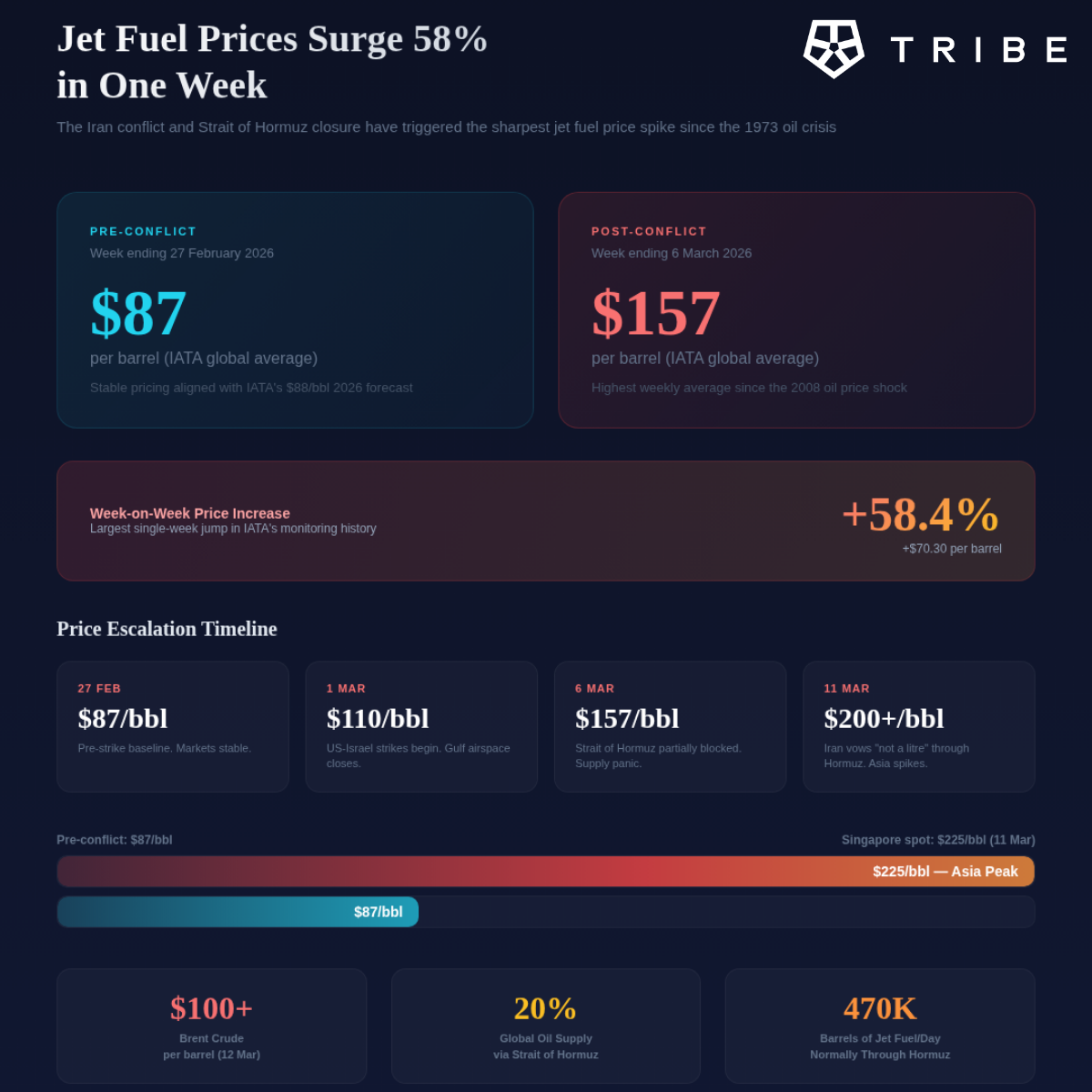
The cost impact has been severe. Jet fuel prices, which sat at $85 to $90 per barrel before the strikes, have surged to between $150 and $200 per barrel — the highest levels since the early days of the Russia-Ukraine war. Qantas, SAS, and Air New Zealand have already announced fare increases, citing the fuel spike directly. Across the industry, operating costs for rerouted long-haul flights have risen by an estimated 40 to 60 per cent.
Private Aviation: From Luxury to Lifeline
While commercial aviation has contracted, private aviation has experienced an unprecedented surge. In the first two weeks of the conflict, charter demand from the Middle East has broken every record on file.
On 5 March, the peak so far , aircraft departures hit 98 in a single day, a 6.5-times increase. Charter enquiries from both individuals and corporate clients have risen tenfold.
Muscat International Airport has emerged as the de facto hub for private aviation evacuations. Private flights now account for 31 per cent of all operations at the normally quiet Omani airport, up from low single digits before the crisis. Its geographic position just outside the most restricted Gulf airspace, with access to the southern bypass route, makes it the logical staging point.
But this surge has come at a price. A light jet from Muscat to Istanbul now costs upwards of $93,000, with heavy jets on the same route reaching $140,000. Before the conflict, the same trip would have cost approximately $60,000, a 142 per cent increase. Some charters from Riyadh to Europe have been quoted at $350,000. One group of 12 passengers chartered a flight from Muscat to Istanbul for $145,000, with their dog.
The drivers are straightforward: extreme demand, limited aircraft availability, repositioning costs (planes return to the region empty), and skyrocketing war-risk insurance premiums.
.png)
Government Evacuations: A Multi-Nation Effort
The conflict has triggered one of the largest peacetime evacuation operations in recent memory, with multiple governments launching repatriation flights for stranded citizens.
The United States has committed up to $40 million to evacuate American citizens, issuing a "Depart Now" order for 14 affected countries. As of 6 March, the State Department reported 18,000 Americans had returned safely, including 8,500 on a single day. Military aircraft and charter flights are being coordinated from regional hubs, though passengers are required to reimburse the government for their seats.
The United Kingdom has dispatched government-chartered flights from Muscat to London Stansted, with further flights planned. The UK Foreign Commonwealth and Development Office is offering seats on a cost-recovery basis.
Australia moved quickly, with the Royal Australian Air Force deploying C-17A and KC-30A aircraft. As of early March, at least four RAAF flights had departed the region, with four more planned within 24 hours.
France, Canada, Germany, and Italy have all launched parallel repatriation efforts, primarily routing through Muscat and Cairo.
Muscat has become the nerve centre for these operations — functioning simultaneously as a government repatriation hub, a private charter staging point, and one of the few operational airports in the region with access to open airspace. Oman's authorities have issued NOTAMs restricting business aviation flights to manage congestion, with diversions now subject to prior approval.
What This Means for Travellers
For commercial passengers, the message from airlines and authorities is consistent: check your flight status directly with your carrier before travelling to any airport in the region. Do not proceed to DXB or DWC without a confirmed, operating flight. Expect delays, cancellations, and significantly longer journey times on routes that normally transit the Middle East.
For business aviation clients, the window for charter evacuation remains open but is narrowing. Aircraft availability is constrained, pricing reflects crisis-level demand, and Muscat's capacity for private operations is under pressure. Early booking and flexible routing are essential.
For the broader aviation industry, the Iran conflict represents the most significant airspace disruption since the Russia-Ukraine war grounded flights over Eastern Europe in 2022 — but at a far larger geographic scale. The closure of Middle Eastern airspace affects a corridor that connects Europe to Asia, Africa to the Indian subcontinent, and Oceania to the West. The economic impact, from fuel costs to lost tourism revenue, is measured in billions.
Looking Ahead
EASA's current bulletin runs until 18 March 2026, with extensions considered likely given the ongoing military situation. The safe resumption of normal operations depends on a de-escalation that, as of this writing, has not materialised.
What is clear is that the global aviation network was not designed to lose its central corridor. The detours are manageable in the short term — but if the crisis persists, the cascading effects on airline economics, passenger flows, and regional connectivity will deepen significantly.
For the latest updates on airspace status and flight operations, monitor EASA's Conflict Zone Information Bulletins and your national aviation authority's guidance.
This article was compiled using verified reporting from official sources including the European Union Aviation Safety Agency (EASA), Dubai Airports, and government repatriation briefings, as well as reporting from Khaleej Times, Gulf News, Al Jazeera, CNN, and other international outlets.
FlyTribe provides aviation intelligence and private aviation advisory services. For enquiries, visit flytribe.ae.
Heading 1

Heading 2
Heading 3
Heading 4
Heading 5
Heading 6
Lorem ipsum dolor sit amet, consectetur adipiscing elit, sed do eiusmod tempor incididunt ut labore et dolore magna aliqua. Ut enim ad minim veniam, quis nostrud exercitation ullamco laboris nisi ut aliquip ex ea commodo consequat. Duis aute irure dolor in reprehenderit in voluptate velit esse cillum dolore eu fugiat nulla pariatur.
Block quote
Ordered list
- Item 1
- Item 2
- Item 3
Unordered list
- Item A
- Item B
- Item C
Bold text
Emphasis
Superscript
Subscript
Author:

Share on:


France's New Air Passenger Tax
12 February 15 Minutes read
Starting March 1, 2025, France will implement higher Air Passenger Transport Tax rates for commercial business jet charter operators.
Heading 1
Heading 2
Heading 3
Heading 4
Heading 5
Heading 6
Lorem ipsum dolor sit amet, consectetur adipiscing elit, sed do eiusmod tempor incididunt ut labore et dolore magna aliqua. Ut enim ad minim veniam, quis nostrud exercitation ullamco laboris nisi ut aliquip ex ea commodo consequat. Duis aute irure dolor in reprehenderit in voluptate velit esse cillum dolore eu fugiat nulla pariatur.
Block quote
Ordered list
- Item 1
- Item 2
- Item 3
Unordered list
- Item A
- Item B
- Item C
Bold text
Emphasis
Superscript
Subscript

AIRBUS ACJ320NEO
ACJ320neo Private Jet
18 December 15 Minutes read
The ACJ320neo combines advanced technology, luxury, and long-range capabilities, offering a superior flying experience. With its customizable interior and eco-efficient design, it’s ideal for both business and leisure travel.
Heading 1
Heading 2
Heading 3
Heading 4
Heading 5
Heading 6
Lorem ipsum dolor sit amet, consectetur adipiscing elit, sed do eiusmod tempor incididunt ut labore et dolore magna aliqua. Ut enim ad minim veniam, quis nostrud exercitation ullamco laboris nisi ut aliquip ex ea commodo consequat. Duis aute irure dolor in reprehenderit in voluptate velit esse cillum dolore eu fugiat nulla pariatur.
Block quote
Ordered list
- Item 1
- Item 2
- Item 3
Unordered list
- Item A
- Item B
- Item C
Bold text
Emphasis
Superscript
Subscript

Onboard Amenities
Dassault Falcon 8X
14 April 15 min read
Master the art of private jet etiquette with our concise guide, ensuring a smooth and enjoyable flight experience.
Heading 1
Heading 2
Heading 3
Heading 4
Heading 5
Heading 6
Lorem ipsum dolor sit amet, consectetur adipiscing elit, sed do eiusmod tempor incididunt ut labore et dolore magna aliqua. Ut enim ad minim veniam, quis nostrud exercitation ullamco laboris nisi ut aliquip ex ea commodo consequat. Duis aute irure dolor in reprehenderit in voluptate velit esse cillum dolore eu fugiat nulla pariatur.
Block quote
Ordered list
- Item 1
- Item 2
- Item 3
Unordered list
- Item A
- Item B
- Item C
Bold text
Emphasis
Superscript
Subscript
